

Monday, January 9, 2012
What's Not To Like?
It wasn't a great weekend to be a fan of the Pittsburgh Steelers. Just when it looked like "Tebow Time" had finally run out - after three straight losses to close the regular season, it appeared that the sun had finally set on the Denver Broncos' miracle run, originally sparked when Tim Tebow was named the team's starting quarterback midseason - the Mile High Messiah propelled his team to victory over the heavily-favored Steel Curtain. Had it been any other quarterback leading the upset, the notoriously passionate Steelers faithful would have been furious, vowing revenge against the perpetrator and cursing his name for all eternity. That's why I was surprised to see the following posted on the Facebook wall of a die-hard Steelers fan:


Saturday, January 7, 2012
City Slickers
While Caught Looking tends to concentrate primarily on mainstream American team sports - baseball, basketball, football and hockey - there's always room to mix in a more obscure athletic spectacle from time to time. I spent my last evening in Manhattan (before I head back to California, that is) at Madison Square Garden, watching the season opener for the Professional Bull Riding (PBR) tour. Years ago I went to a smaller-scale rodeo in Fort Worth, Texas, but had only seen bull riding on television before Friday night. Though the MSG version of the PBR tour might not be completely reflective of what the circuit is all about, the event certainly brought some country-style fun to the typically urban Garden atmosphere.
Professional Bull Riding drew a very unique crowd to MSG. While some of the people in attendance were legitimate bull riding fans - most likely transplants from other parts of the country now residing in New York City - more (like me) were there just to see what the event was all about. Of the "non-fans," many appeared to be recent college graduates still stuck in the frat party mindset who saw the PRB tour event as an opportunity to throw on a cowboy hat, a short denim skirt and a pair of cheap cowboy boots and drink large quantities of overpriced beer. There was a lot of excessive drinking (much more so than at a typical Knicks or Rangers game at the Garden), a lot of obnoxious twenty-somethings and a lot of valley girl accents all around us.
Once I got past the rather unsavory spectators in my section, though, I started to enjoy the event. Unless you're some sort of animal rights activist, I'd bet you'd find the PBR tour extremely entertaining. The bulls are giant, the riders are fearless and the rodeo clowns are humorous - usually unintentionally, but amusing nonetheless. The PBR puts on a much more professional event than I anticipated, too - while the "playing surface" itself it little more than a ring of dirt, the riding area is surrounded by ad-covered fencing and is backed by a giant video board and a host of other bull riding-related advertising. Though companies like Dewalt tools, Cooper Tires and Pabst Blue Ribbon beer don't normally secure advertising inventory inside the world's most famous arena, they seemed right at home plastered around the bull riding ring. At the same time, the PBR did seem to try to appeal to a more modern, urban crowd by replacing traditional country background music with mostly hip-hop.
The biggest negative about going to a PBR tour event is the lack of explanation as to what's going on. When you go to a Knicks game at MSG, you likely don't think about the fact that it would be virtually impossible to follow all of the action had you never seen a basketball game before. During the bull riding, the announcers don't say much other than the score given to the rider after each ride - you quickly realize what it would be like to watch your first baseball or football game. After watching a few rides, I was able to pick up the basics - the rider gets points based on how long he stays on the bull and how violent the ride was, and the bulls are scored similarly but in reverse - but couldn't really follow exactly how the scoring worked and wasn't able to distinguish a challenging ride from a tamer one. Though the PBR tour might hope that spectators can follow the action alone, perhaps in future years they should do a better job anticipating a less-savvy-than-usual crowd when they head to New York City.
Professional Bull Riding drew a very unique crowd to MSG. While some of the people in attendance were legitimate bull riding fans - most likely transplants from other parts of the country now residing in New York City - more (like me) were there just to see what the event was all about. Of the "non-fans," many appeared to be recent college graduates still stuck in the frat party mindset who saw the PRB tour event as an opportunity to throw on a cowboy hat, a short denim skirt and a pair of cheap cowboy boots and drink large quantities of overpriced beer. There was a lot of excessive drinking (much more so than at a typical Knicks or Rangers game at the Garden), a lot of obnoxious twenty-somethings and a lot of valley girl accents all around us.
Once I got past the rather unsavory spectators in my section, though, I started to enjoy the event. Unless you're some sort of animal rights activist, I'd bet you'd find the PBR tour extremely entertaining. The bulls are giant, the riders are fearless and the rodeo clowns are humorous - usually unintentionally, but amusing nonetheless. The PBR puts on a much more professional event than I anticipated, too - while the "playing surface" itself it little more than a ring of dirt, the riding area is surrounded by ad-covered fencing and is backed by a giant video board and a host of other bull riding-related advertising. Though companies like Dewalt tools, Cooper Tires and Pabst Blue Ribbon beer don't normally secure advertising inventory inside the world's most famous arena, they seemed right at home plastered around the bull riding ring. At the same time, the PBR did seem to try to appeal to a more modern, urban crowd by replacing traditional country background music with mostly hip-hop.
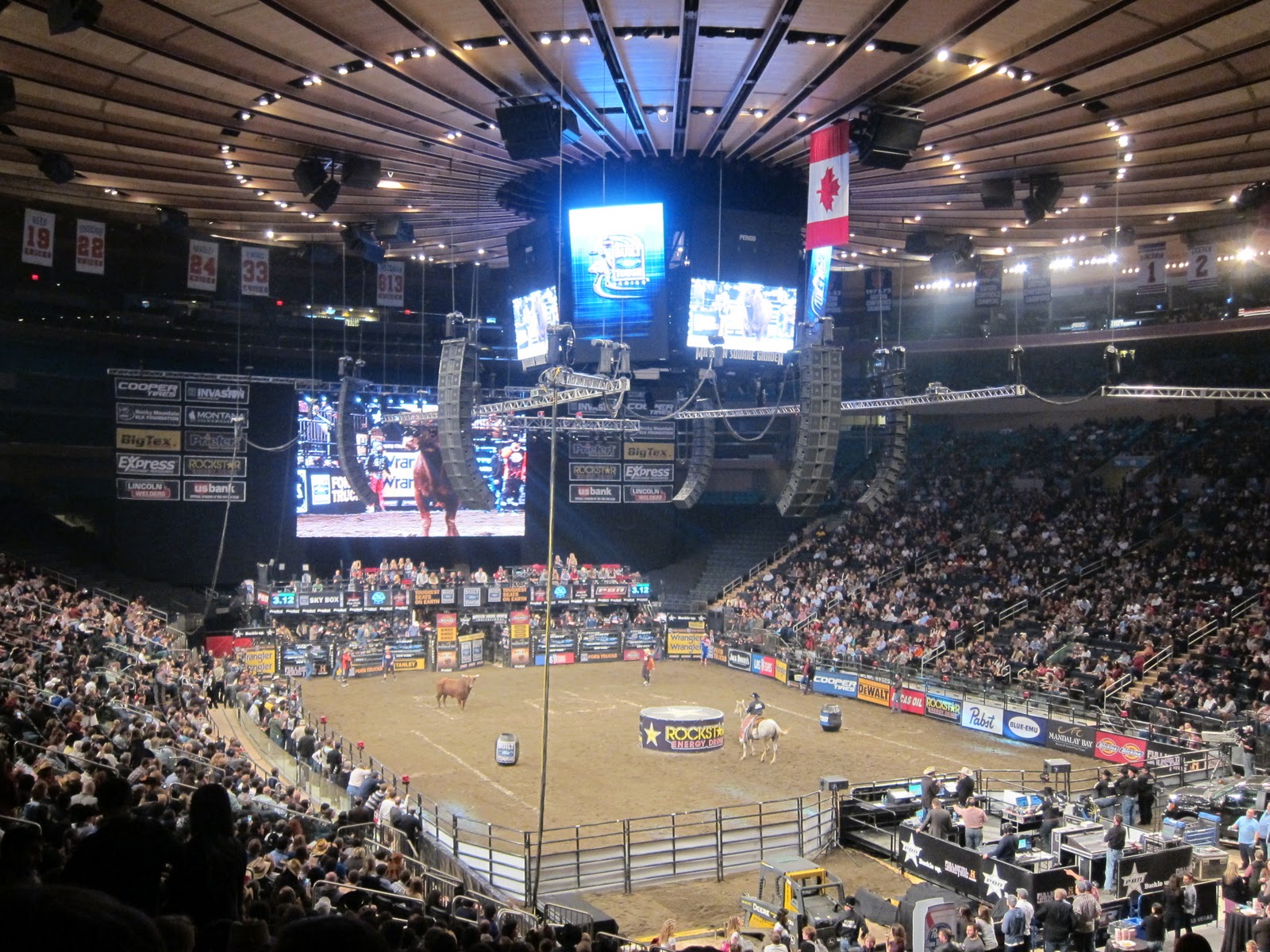
The PBR tour involves a lot more infrastructure than a simple ring of dirt.
The biggest negative about going to a PBR tour event is the lack of explanation as to what's going on. When you go to a Knicks game at MSG, you likely don't think about the fact that it would be virtually impossible to follow all of the action had you never seen a basketball game before. During the bull riding, the announcers don't say much other than the score given to the rider after each ride - you quickly realize what it would be like to watch your first baseball or football game. After watching a few rides, I was able to pick up the basics - the rider gets points based on how long he stays on the bull and how violent the ride was, and the bulls are scored similarly but in reverse - but couldn't really follow exactly how the scoring worked and wasn't able to distinguish a challenging ride from a tamer one. Though the PBR tour might hope that spectators can follow the action alone, perhaps in future years they should do a better job anticipating a less-savvy-than-usual crowd when they head to New York City.
Thursday, January 5, 2012
Cosmetic Changes Not Enough
Although it wasn't my first trip to the newly partially-renovated Madison Square Garden (I was there for Duke versus Washington last month), last night's Knicks game versus Charlotte was my first chance to really take in the various changes made to the venue. Having arrived about an hour before tip-off, I got to walk around the newly remodeled 100-level concourses and take in the various upgrades - new marble floors, modern bathrooms, varied concessions and new seats now adorn the lower level of the world's most famous arena. Look closer, though, and you'll quickly notice that all of the cosmetic changes can't really mask what's still the same old MSG. The upgraded concession stands serve mostly the same old food, the new seats are already run down (it took us about 15 minutes to break one of our cup-holders), and the floors throughout the arena are still sticky from spilled beer. While the arena might look a little different, it'll be a while before it's transformed into something truly great.
The same can be said of the New York Knicks right now. While much has been made about the team's additions - including star center Tyson Chandler, veteran Mike Bibby and rookie Iman Shumpert - they're still the same old Mike D'Antoni-led, no-defense Knicks. The game, which New York lost 118-110, wasn't nearly as close as the still-lopsided score indicates, as the star-studded Knicks were out-classed, out-hustled and out-played by a more aggressive Bobcats squad. Boos rang from throughout the arena as the home team continually failed to get back on defense, contest open jump shots or challenge drives to the hoop. It was as depressing an atmosphere as I've ever seen at the Garden, as if fans were for the first time realizing that, despite the team's cosmetic changes, they're still the same old Knicks.

As I periodically remind the readers of Caught Looking, the point of this blog is not to critique players, coaches or management for on-court performance - that's the job of the mainstream sports media. That being said, I do feel a duty to call for coach Mike D'Antoni's head on the grounds that he's a terrible fit for New York's basketball culture. Aside from the fact that I don't think D'Antoni's Seven Seconds or Less strategy can ever bring a team an NBA Championship (though what do I know?), I also don't think Knicks fans in particular will ever fully embrace a style of play that encourages rushed threes, lazy defense and limited rebounding. Ask the average young to middle-aged Knicks fan who his favorite player is, and he's almost sure to name a player known for his defense and / our toughness. Patrick Ewing, Charles Oakley and Anthony Mason are true modern Knicks heroes; I don't know if Mike D'Antoni's crew of shoot-first "superstars" will ever be viewed in the same positive light.
A professional basketball coach has two main jobs - to win basketball games and to please the home crowd while doing it. Since he came to New York, Mike D'Antoni hasn't done much or the former and is currently doing an even worse job at the latter. Just like the "new" MSG that I got to explore last night, the 2011-12 New York Knicks have made a bunch of cosmetic changes that, in reality, haven't changed anything. What's more disappointing, though, is that the Knicks brass is hoping that the team, and their fans, will buy into a strategy that's simultaneously unreliable and un-New York. If Mike D'Antoni wants to keep his job, he might want to think about embracing defense, both to win basketball games and win over the MSG crowd.
The same can be said of the New York Knicks right now. While much has been made about the team's additions - including star center Tyson Chandler, veteran Mike Bibby and rookie Iman Shumpert - they're still the same old Mike D'Antoni-led, no-defense Knicks. The game, which New York lost 118-110, wasn't nearly as close as the still-lopsided score indicates, as the star-studded Knicks were out-classed, out-hustled and out-played by a more aggressive Bobcats squad. Boos rang from throughout the arena as the home team continually failed to get back on defense, contest open jump shots or challenge drives to the hoop. It was as depressing an atmosphere as I've ever seen at the Garden, as if fans were for the first time realizing that, despite the team's cosmetic changes, they're still the same old Knicks.

MSG and the Knicks have a ways to go before any real changes are made.
As I periodically remind the readers of Caught Looking, the point of this blog is not to critique players, coaches or management for on-court performance - that's the job of the mainstream sports media. That being said, I do feel a duty to call for coach Mike D'Antoni's head on the grounds that he's a terrible fit for New York's basketball culture. Aside from the fact that I don't think D'Antoni's Seven Seconds or Less strategy can ever bring a team an NBA Championship (though what do I know?), I also don't think Knicks fans in particular will ever fully embrace a style of play that encourages rushed threes, lazy defense and limited rebounding. Ask the average young to middle-aged Knicks fan who his favorite player is, and he's almost sure to name a player known for his defense and / our toughness. Patrick Ewing, Charles Oakley and Anthony Mason are true modern Knicks heroes; I don't know if Mike D'Antoni's crew of shoot-first "superstars" will ever be viewed in the same positive light.
A professional basketball coach has two main jobs - to win basketball games and to please the home crowd while doing it. Since he came to New York, Mike D'Antoni hasn't done much or the former and is currently doing an even worse job at the latter. Just like the "new" MSG that I got to explore last night, the 2011-12 New York Knicks have made a bunch of cosmetic changes that, in reality, haven't changed anything. What's more disappointing, though, is that the Knicks brass is hoping that the team, and their fans, will buy into a strategy that's simultaneously unreliable and un-New York. If Mike D'Antoni wants to keep his job, he might want to think about embracing defense, both to win basketball games and win over the MSG crowd.
Wednesday, January 4, 2012
An Emotionless Ending
Having your team lose its last game of the season always sucks. You're left with a bad taste in your mouth for the entire offseason, find yourself thinking about various "what ifs" for days or even weeks, and long for the next season to start so that your team can redeem itself. When a final contest materializes as a close game and / or with the postseason on the line, these losses can be especially painful. I'm still thinking about the excruciating way the Braves dropped their last three games of the season to the Phillies this past MLB season, squandering a seemingly guaranteed shot at the playoffs, and Princeton's failed buzzer beater attempt against Kentucky during the 2011 NCAA Tournament still finds its way into my thoughts from time to time.
I'm pretty sure, though, that Stanford's Fiesta Bowl defeat at the hands of Oklahoma State on Monday night won't ever be one of those games that keeps me up at night. Although the Cardinal ended the Andrew Luck era in especially devasting fashion - missing a relatively easy field goal at the end of regulation that would have handed Stanford a three-point win, and instead losing in overtime after yet another missed kick - it hasn't bothered me much over the past two days. As much as I now love Stanford football and spent so much time over the past two seasons rooting for and following the Card, the quirks of the BCS system don't really make Stanford's loss worth worrying about.
Postseason losses are so frustrating because they mean the end of the road for your team. For teams like the Braves or Princeton basketball, losses to the Phillies and Kentucky, respectfully, meant that their seasons had come to an end. I never got a chance to find out if Atlanta's young rotation and up-and-coming lineup could do some damage in the postseason. I'll never know if Princeton could have pulled another shocking upset in the Round of 32 and become the second Ivy League school in a row to advance to the Sweet 16. Their losses robbed me of those answers, and turned my questions into mere hypotheticals. In NCAA football, there is no next playoff game, win or lose. The difference between being Fiesta Bowl champions and Fiesta Bowl losers is surprisingly minimal. Regardless of this game's outcome, Stanford was going back to Palo Alto without a shot at the National Championship. Even if Stanford had made that kick at the end of regulation, their season would have ended, their journey over.
Of course I would much rather have had Stanford win the Fiesta Bowl than have lost it. But the most exciting thing about professional sports isn't winning a championship - it's the journey that leads to a championship. NCAA football's current BCS system robs fans of that journey, to a point where even the best teams - Stanford among them - have little to play for after the end of the conference season. In a weird way, I cared much more about seeing Stanford get to a BCS Bowl game than about how they did in the bowl game itself. Until fans get their much sought after major college football playoff system, the NCAA football postseason will always lack the passion and emotion associated with other sports.
I'm pretty sure, though, that Stanford's Fiesta Bowl defeat at the hands of Oklahoma State on Monday night won't ever be one of those games that keeps me up at night. Although the Cardinal ended the Andrew Luck era in especially devasting fashion - missing a relatively easy field goal at the end of regulation that would have handed Stanford a three-point win, and instead losing in overtime after yet another missed kick - it hasn't bothered me much over the past two days. As much as I now love Stanford football and spent so much time over the past two seasons rooting for and following the Card, the quirks of the BCS system don't really make Stanford's loss worth worrying about.
Postseason losses are so frustrating because they mean the end of the road for your team. For teams like the Braves or Princeton basketball, losses to the Phillies and Kentucky, respectfully, meant that their seasons had come to an end. I never got a chance to find out if Atlanta's young rotation and up-and-coming lineup could do some damage in the postseason. I'll never know if Princeton could have pulled another shocking upset in the Round of 32 and become the second Ivy League school in a row to advance to the Sweet 16. Their losses robbed me of those answers, and turned my questions into mere hypotheticals. In NCAA football, there is no next playoff game, win or lose. The difference between being Fiesta Bowl champions and Fiesta Bowl losers is surprisingly minimal. Regardless of this game's outcome, Stanford was going back to Palo Alto without a shot at the National Championship. Even if Stanford had made that kick at the end of regulation, their season would have ended, their journey over.
Of course I would much rather have had Stanford win the Fiesta Bowl than have lost it. But the most exciting thing about professional sports isn't winning a championship - it's the journey that leads to a championship. NCAA football's current BCS system robs fans of that journey, to a point where even the best teams - Stanford among them - have little to play for after the end of the conference season. In a weird way, I cared much more about seeing Stanford get to a BCS Bowl game than about how they did in the bowl game itself. Until fans get their much sought after major college football playoff system, the NCAA football postseason will always lack the passion and emotion associated with other sports.
Sunday, January 1, 2012
A Tale of One City
While watching the third quarter of what would eventually be a division-clinching victory for the New York Giants over the Dallas Cowboys, I saw a commercial for Pepsi Max featuring New York Jets head coach Rex Ryan, quarterback Mark Sanchez and the rest of Gang Green. Earlier today, I also watched the majority of the Jets' season-ending loss to the mediocre Miami Dolphins, but didn't see Giants head coach Tom Coughlin or quarterback Eli Manning selling any zero-calorie carbonated soft drinks. All season, New York football has been a story of the Jets failing to live up to all the hype that surrounded them throughout the season, and of the Giants overcoming injuries and adversity to take the NFC East title. Today more than any other this season, I'm proud to be a fan of the 2011 New York Giants.
While I'm happy that the Giants will get to host the Atlanta Falcons in the first round of the NFC playoffs next weekend, I'm even more proud of the effort that my Giants put forth the entire season. From the start of the preseason, all I heard was talk about how the Giants were no match for the more talented (on paper, anyway) Philadelphia Eagles and Dallas Cowboys. People wrote off Big Blue when they dropped their season opener in Washington, and again when they lost tough games to New Orleans, Green Bay and Philadelphia later in the year. At the same time, many crowned the Jets as the AFC favorites before any games were played. As a result, the Jets got the bulk of the endorsement deals. At the end of the season, though, the Giants got the bulk of the wins.

I'm the first to admit that there's no real rivalry between New York's two NFL franchises. With the exception of last week, when the Giants beat the Jets at MetLife Stadium in what was technically a road game, the two teams rarely impact each other. This year, however, the two battled for much more than the newspaper headlines - the Giants victory all but ended the Jets' season even before Gang Green played an uninspired game in Miami today. On the flip side, Rex Ryan's constant trash talk fired up the Giants to the point that Big Blue not only took down the Jets, but rode the momentum through tonight's impressive and complete victory over Dallas. As a fan of hard-nosed football, I couldn't be more happy about the way the regular season ended for the Giants - the team let their play do the talking, put together two of their best games of the year and earned a well-deserved playoff home game.
I don't in any way think that the Jets extracurricular activities - the commercials, the trash talking, the spotlight - had anything to do with the team's disappointing 2011 season, just like I don't believe that some sort of "No one believes in us!" mentality is what propelled the Giants to a strong finish and the playoffs. Instead, I believe that the Jets were overrated from the start and that the Giants were deeper and better prepared than many people gave them credit for. At the same time, though, the alignment between the Giants' blue-collar work ethic and NFC East title is extremely satisfying to Giants fans everywhere. And I'd be lying if I said that the correlation between the Jets' sense of entitlement and late season collapse wasn't a little bit satisfying, too.
While I'm happy that the Giants will get to host the Atlanta Falcons in the first round of the NFC playoffs next weekend, I'm even more proud of the effort that my Giants put forth the entire season. From the start of the preseason, all I heard was talk about how the Giants were no match for the more talented (on paper, anyway) Philadelphia Eagles and Dallas Cowboys. People wrote off Big Blue when they dropped their season opener in Washington, and again when they lost tough games to New Orleans, Green Bay and Philadelphia later in the year. At the same time, many crowned the Jets as the AFC favorites before any games were played. As a result, the Jets got the bulk of the endorsement deals. At the end of the season, though, the Giants got the bulk of the wins.

Few people expected much from Victor Cruz or the rest of the Giants this season.
I don't in any way think that the Jets extracurricular activities - the commercials, the trash talking, the spotlight - had anything to do with the team's disappointing 2011 season, just like I don't believe that some sort of "No one believes in us!" mentality is what propelled the Giants to a strong finish and the playoffs. Instead, I believe that the Jets were overrated from the start and that the Giants were deeper and better prepared than many people gave them credit for. At the same time, though, the alignment between the Giants' blue-collar work ethic and NFC East title is extremely satisfying to Giants fans everywhere. And I'd be lying if I said that the correlation between the Jets' sense of entitlement and late season collapse wasn't a little bit satisfying, too.
Subscribe to:
Comments (Atom)